"The Returnee..."

We are in the middle of a roller coaster of transition. We left Uganda on 1st July, and travelled to visit Dan's family in America... Now we arrive in England, where I have not lived since 1992, almost twenty years ago... I left young free and single, and return with an American husband and two children, aged 11 and 9... I hope to describe the experiences of "the Returnee", with, no doubt, flashbacks to our African life, and commentary from my children along the way...

Monday, 16 July 2012

Strawberries and Cream...

My non-British friends may or may not know this, but if you were asked to epitomise an English summer, you would probably say: strawberries and cream, garden parties with Pimms and lemonade, Wimbledon on the TV, cricket (for some), picnics in the park/countryside, family days on the beach...

Nothing beats an English summer. But this year something has gone wrong...! Honestly, my first English summer for years! Worse than usually wrong, that is. OK, we always get quite a lot of rain, but this year, we have had a LOT a lot of rain. The wettest summer since records began 100 years ago. Flooding all over the country. Nine out of ten cricket matches, parties, BBQs, and open air concerts cancelled because of... the rain.

(not my pictures, I am glad to say)
Gloucester has thankfully escaped scenes like these...
Tewkesbury, just a few miles north of us, earlier in July
 According to the weather-men, the problem is the Gulf Jet Stream, which normally sweeps down and  around the Atlantic Ocean bringing us warm sunny summer weather on its right shoulder - but which has this year dropped south by a very long way, leaving us on its left shoulder and therefore in the rain and cold. For weeks. Temperatures of 12 to 15 degrees when it should be high 20s. These graphics I stole from Google give the idea:


I really needed the sunshine too... but, it looks as though this weather pattern is going to be with us until at least the end of July. Possibly until September. Aaaaaaggghhhhhh!!!

But we are trying to be British and stoical and making the best of it. The evenings are still light until nearly 10.00 pm, so that helps. Walking with Frodo come rain or shine also helps. Alex has managed to play a few cricket matches:


And yesterday Alex and I went strawberry-picking, and today we all feasted on meringues, strawberries and clotted cream... mmmmmmmm...


Friday, 13 July 2012

Beauty, William Morris and the Cotswolds


Yesterday it didn't rain... (for a couple of hours) so I took a break from washing bedding, picking up stuff off Alex's floor until I could actually see the floor, hoovering the stairs, etc, and Abby Frodo and I went for a walk. Gloucester is just on the edge of one of England's prettiest regions, called the Cotswolds. The Cotswolds is a range of gentle hills, mostly countryside, dotted with honey-coloured stone cottages and ancient, sweet villages. We went to Bibury, which is one of the best-known and most-visited villages. It has a clear, wide stream flowing along its main street and past rows of cottages, with ducks, and yesterday even adorable ducklings floating along, and you can see large spotted trout down in the water. We are fortunate to live close to such a beautiful part of England and look forward to exploring it more...


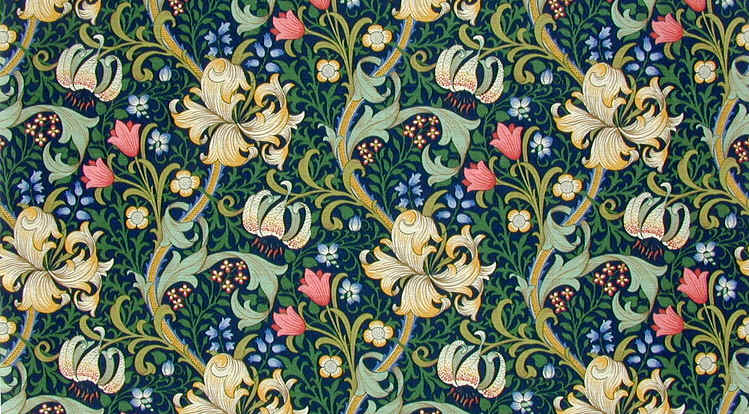
Apparently the famous artist, poet and designer William Morris once called Bibury "the prettiest village in England." William Morris created the most beautiful designs, so he must know. I used to have William Morris posters up on my bedroom walls, - in the days when I used to have arty posters on my walls. I've grown up loving his work but not knowing much about him. He lived from 1834 - 1896 and was one of the leaders of the "Arts and Crafts" design movement.

William Morris wallpaper designs


This is an excerpt I pinched from a website about him:

William Morris 1834 - 1896

Poet, artist, conservationist, craftsman, calligrapher, printer, socialist and "dreamer of dreams": William Morris was all of these and more. Born in 1834, much of Morris' life was influenced by the Cotswold countryside. Kelmscott Manor near Lechlade, not far from Bibury, became his country home from 1871 until his death in 1896. Kelmscott played an important part in his life and can still be visited today.
Morris was one of the leaders of the Arts & Crafts Movement which flourished from 1850 - 1920 and spread across Europe and North America. Many of his followers remained in the Cotswolds, and this tradition is still alive today, and inspiration for artists and craftworkers in the countryside.


Monday, 9 July 2012

The Best Exotic Marigold Hotel

I have just watched this warm, fun movie, about a group of retired Brits who decide for various reasons to move to India for their old age - to the "Best Exotic Marigold Hotel". It has some humorous, and poignant, observations about moving to another culture as well as many very funny lines. Also some beautiful, noisy and colourful scenes of Indian street life. From my very brief trip to India in 2007 for CV Mathews' enthronement, I second that India is "an assault on all the senses," that the comment of one character, "All life is here" is true, and also that the hair-raising shot of an overtaking bus honking and swishing across into its own lane just in time is all too authentic - the driving was noisier and more frightening by far than in Uganda.

It is a comedy, and it has some fairly ridiculous incidents and probably a lot of cliches. But, I enjoyed it very much and I totally recommend it. The most obvious observation on moving into a new culture is the truism that, the more you put into a thing, the more you get out of it. The characters who ventured out into the streets and markets and then into the lives and finally homes of Indian friends, were the ones who came to love it the most and made the best new life in India.  Another point made simply but well was that you must, must show respect toward and interest in people; and when you are invited into someone's home and are not sure what is expected, just be considerate, and real. Just as you would with a new friend of your own culture, in fact. A more insightful observation came across more subtly: early on the narrator described the group as "adapting to new ways and new habits like Darwin's finches"; but towards the end of the film she says, "Perhaps we were foolish to think we could adapt at our ages. We are too stuck in our ways." Early on in transition to a new culture, you can think that you are making fantastic progress, you know so much already, and you are adjusting brilliantly to the new life. But as you go along, you find out more and more how deep culture goes, both for you and for those you now live among, and you find out just how much you do not know and will probably will never know or completely understand. The challenge becomes greater and harder the longer you stay. That is my belief. Doesn't mean you shouldn't keep at it, keep learning - but you have to be humble, and very patient about it!

Two very amusing lines: when one of the wives is annoyed with her husband, she says to him: "When I want your opinion I'll give it to you." And the one that appears in the trailer, - "In India we have a saying, everything will be all right in the end. So if everything is not all right, it means it is not the end yet." Good one. I do recommend this film for a fun and feel-good couple of hours set in another bright and sunny country.

Thursday, 5 July 2012

One Year On...

It is just over a year since we left Uganda. Can't believe it has been that long already. For me the first half of the year went by soooo slooowly. Everything seemed to be difficult and challenging; it seemed like I was climbing an interminable mountain of tasks and church visits. But in about March, when the church visits were over, we started choosing how to spend weekends, we stopped travelling about, and when life settled into more of a routine, then life quickened and became manageable, work became less scary and more under control, and things suddenly started to rush along. I began to feel as though I was building a new life, making new friends, actually enjoying things. It partly coincided with my embarking on my chocolate cure... And largely was just a matter of time, as relationships and involvements do grow slowly.

So suddenly I find myself struggling to believe we have been here a year.

Looking back on my experiences, I would probably give these tips to anyone starting out on the returnee lark...

Give yourself plenty of time, as in, don't rush into any commitments or job if possible, and allow yourself to have breaks, weekends to yourselves as a family, or with your family or familiar friends, every other weekend at least. It is tiring and you need downtime...
Don't expect to feel at home for ages. Don't feel sad if you don't yet feel at home.
Treat yourself to the things you have been missing... I didn't let myself indulge in either much chocolate or much alcohol until about February. I don't know why really - partly because I was doing the shopping, and I was trying to keep within a very small budget.
Don't pretend you know what is going on, but ask all the questions (eg what was that TV show, what does that word mean, how do I pay for a parking ticket...), - keep asking for help.

That is just a few things.

I asked Abby and Alex what things they are still missing and what things they are enjoying about living here, one year on.

Abby is still missing the campus life, the freedom to roam and play over such a big green open area. And she said she is missing the lovely swimming - the few pools we have gone to here are so crowded in comparison to the Colline or Kingfisher. She is also missing the food that she liked in Uganda, in particular, the sausages there! English sausages are all too spicy or peppery. And the Paramount gouda that the rest of us tired of - no cheese in England is that perfect blandness for her...! But, she loves her school and the friends she has made here, and seeing her grandparents and cousins so much more often.

Alex is also missing the freedom of campus and all the playing outdoors barefoot. He misses his friends on campus. But, he loves the fact that there is so much to do here, as in places to go for day trips and outings, and the sports he is able to do here - hockey club and cricket club. He loves the ease of getting things he wants... (he has just spent all his saved-up pocket money on a stunt scooter - ordered on Amazon and it arrived in two days.)

I am enjoying the countryside and almost daily walking, the constant change of the trees and the appearing of new flowers; still loving the smooth roads, the convenience of life in general (atms everywhere, post offices everywhere, a corner shop to buy milk just a two minute walk away,) the electricity being on all the time, internet working all the time; seeing my family often; variety of diet; being able to drink sherry or a gin and tonic while I am cooking, and anytime (don't worry, I am not drinking very much at all!); being a normal anonymous person everywhere I go. The things I still miss about Uganda, as well as friends, are: the sunshine, the light and warmth in the air; being able to throw on a t-shirt every day without thinking about it; the warmth of daily encounters with Florence, students, colleagues and neighbours; the birds; the beauty.

So it is still a mixture, and it probably always will be. Looking back, it hasn't been an easy year, but, we have been through an unavoidable valley and we are coming into the new land.

Monday, 2 July 2012

The thin ice revisited...

Thinking back over my previous post, I felt that the metaphor I used about walking on thin ice for eleven months was not quite right, as it sounds ungrateful to all those who were there for us and helped us through that time. Let alone, to God who looked after us. We did have many one-off gifts from churches and individuals, and the offer of help from family, and, help from family. Our bank balance never even got scary over the time, it kind of stayed at a certain level. My job was also a gift which helped us keep going.

I know my problem - my security is too much based in human things. My faith is in a salary, a home, paid bills, a plan, school places for the children, good relationships with parents, colleagues and friends.
Like I was saying before about Jonah, my security really needs to be in God. O ye of little faith.

I hope that I have learned a bit more faith through this experience. I think I feel less anxious about the future, that I know everything is in hand, someone is looking after us... Someone with a better plan than mine. Someone who knows a lot more than me.

We were walking over a long long lake of ice, but we had boats nearby. And maybe also what I needed to learn was that, the lake was never very deep after all.

Dan has gone to work! At Redcliffe College

Today is a Red Letter Day, for me if for no-one else... Dan has started work!!!! This is officially his first day as Head of Theology at Redcliffe College. No matter that the students all just left for the summer break... Dan is there, getting ready for their return, manning the college during the break, ready to welcome visitors and potential students, attending planning meetings, moving into his new office, (OK, still tweaking his PhD - although the first draft is 99 % done), and, earning some money!

Redcliffe is a wonderful college that we are blessed to be part of. It is a missions training college that moved from London about 25 years ago, into a beautiful Georgian building here in Gloucester. The staff team is quite small and so everyone is involved up to their necks, which makes for a good community.

Redcliffe has students from about 30 countries, training in theology, missions, and cross-cultural studies. It is accredited by the University of Gloucestershire, so that the students come away with recognised BAs and MAs. There are a number of interesting MA courses including one in Justice, Advocacy and Reconciliation, one in Member Care, one in Sports and Mission, MAs in European and Asian Mission studies, and others.

www.redcliffe.org


Our connection with Redcliffe seems to have always been by divine appointment, and goes back to 2002, when we had to leave Zimbabwe at very short notice. We had friends, Nick and Jenny Cole, who worked at Redcliffe for a while, and on a previous home leave we had visited them, and Nick had mentioned in passing that Redcliffe always had "visiting scholars," and if we ever wanted a sabbatical we could all go and live in the college accommodation and do some teaching for a term. So, when we were given three months to leave Zimbabwe, we contacted the college and asked if they could use us straight away!

Sure enough they took us on, so we moved into a college family house (five families with ten children all under the age of ten in one big house, sharing one kitchen, one washing machine, one living room...! Chaos but a lot of fun.) It was completely a gift from God for us that year. Abby was two and Alex a baby when we moved there. I don't know what else we would have done at that point. So we were extremely thankful to Redcliffe and to God. Also, Redcliffe was just starting up the MA courses that year, and getting a big review done, so the lecturers were very happy to have Dan and me teaching some of the undergrad and core courses, so that they could work on these big projects. We loved our year there.


So when in 2010 we felt it was about the right time to leave UCU, we contacted Redcliffe again (as well as some other places) and the principal came back to us saying that their head of Theology would be retiring, and they would be interested in having Dan as his replacement.

We are very happy to have this work, still involved with missions and particularly preparing people to go out on missions, living in this beautiful area of England, and well placed for all my family.

Today feels like a miracle, though, because, although Rob the principal emailed Dan that they did want him for the job about a year and a half ago, they were unable to give us anything definite, in writing, until May this year! So, we moved to Gloucester largely in faith, - faith in God and faith in Rob Hay(!), that the job would in actual fact be Dan's. It has been like walking on thin ice over a huge, eleven-month-long lake, trusting that we would reach the other side and find firm ground. Well, today it seems that we have reached it. Whew!!!!!


Dan's office is the top right window, in the roof! More photos to follow...

This shows the accommodation for students, and the garden with a sweet playground for little children, and a beautiful, huge conker tree.

The same tree, with crocuses in early Spring.


Thursday, 28 June 2012

Wolf Hall


Historical novels set in Tudor times are fantastic - well-written ones that is - because the times were so turbulent, the clothes so colourful and opulent, the debates were about matters of faith, people rode horses everywhere or travelled up and down the Thames in rowing boats and barges, and ate a lot of meat and bread off trenchers, and threw the bones onto the straw-strewn floors - it all sounds kind of romantic and fun. Ladies had admirers who wrote them poems and sonnets. Tudor people lived either in castles, or in black and white beamed houses with upstairs windows jutting out into the streets and diamond-paned windows. They had open fires in each room, and jesters.

OK, this is probably the rich people only. If I lived in Tudor times, I would be some "goodwife" probably, wearing long dresses and aprons and kind of mobcaps, and carrying baskets of bread or washing around.


The poor people in Tudor times lived in mud-walled, thatched houses, worked the fields or were servants for others, and were uneducated and heavily taxed and very very poor.

I do seem to have only a very rudimentary grasp of Tudor life. But I like the houses, the dresses, the colours, the woodcuts, tapestries, and harpsichord music. But I expect I would have hated the cold and draughts everywhere, the smells because I don't think people washed very often, and the filthy streets. And the violence. In these times people were burned at the stake for their religious beliefs, or sometimes tortured for information and confessions, and then burned or beheaded - first the ones who wouldn't give up their catholic faith, and then the ones who did turn to the new protestant faith, and then the catholic ones again - all depending on the views of the monarch of the time. It swung one way and then another... People got hung up by their thumbs, put in iron spiked cages that closed on them slowly, stretched and dislocated on racks, you name it... It is all anathema to me, but I love reading about it!


I find it interesting that our evangelical protestant churches, those who believe everyone should have a Bible in their own home, in their own language, who are opposed to superstition, opposed to the notions of purgatory and confession to a priest and paying a priest to pray for your dead relatives, in other words, the churches I am aligned with, - that they came into existence through this process of burnings, confessions, torture, and the shutting down and even sometimes physical destruction of ancient, beautiful monasteries. Why did God have to birth the Protestant church in England in this way? I suppose it must be a bit like why the Israelites had to wipe out the Canaanites - the softly softly approach just wouldn't have got anywhere. But it was an inevitable and gradual process in fact, as people of faith saw the church, which was all catholic then, becoming more and more corrupt, and also as they longed to be able to read the Bible in English, and as the printing presses were built that made reproduction of those Bibles possible. The reformation didn't just start with Luther, and nor did it come into England just because Henry VIII wanted to be free from the Pope in order to divorce his wife and marry his mistress Anne Boleyn. Rather, it started in myriads of places throughout England and Europe, as people's yearning rose up for genuine understanding and faith and worship and they became determined to be set free from the superstitions, the faith in relics and paid-for prayers. I am extremely glad the Reformation happened, but, in spite of my romance with the Tudors, I am glad that I didn't have to live through it. I don't think I am brave enough to be burned at the stake. Seriously.

Wolf Hall is a brilliant novel set in those days. It is written by Hilary Mantel, who is an excellent writer. Her descriptions of people are evocative: for example, this is the first appearance of the Duke of Norfolk: "Flint-faced and keen-eyed, he is as lean as a gnawed bone and as cold as an axe-head; his joints seem knitted together of supple chain links, and indeed he rattles a little as he moves, for his clothes conceal relics: in tiny jewelled cases he has shavings of skin and ... splinters of martyrs' bones." The main character is Thomas Cromwell, who is normally portrayed as an ambitious, cruel self-made man - but in this book he comes across as a sensitive and caring, if pragmatic, reformer, who wants to get ahead. Whilst Thomas More, who is normally presented as a kindly, moderate man, in this book comes across as tactless and unpleasant. If you are a fan of historical novels, this one is absolutely fantastic and gripping, highly researched but not at all dry; it draws you into the world of the day, court life, Henry VIII's relationship with Anne Boleyn (and other women), Anne Boleyn's and Katherine of Aragon's perspectives - you understand them all and swing between sympathising with each in turn. I had never understood how Cardinal Wolsey, Thomas Cromwell, Thomas More and Cranmer related to each other and fit into the chain of events, until I read this novel - now I have got it down. I thoroughly recommend this book. Can't wait to read the sequel...